Art Workers Radical Practice in the Vietnam War Era
FEATURE
Culture Corps
Art Workers: Radical Practise in the Vietnam War Era Past Julia Bryan-Wilson. University of California Press. Hardcover, 256 pages. $39.
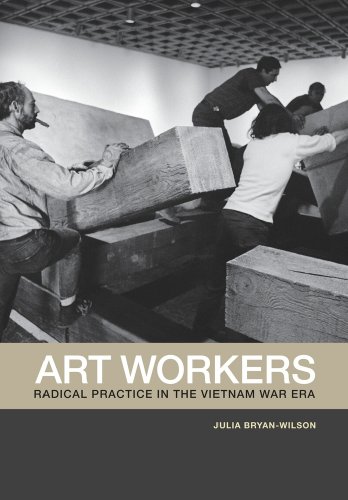
Whirling kinetic sculptures, heaps of rough timber, spills of cast physical, coiling bands of telex paper spewing raw news feed: How did artists making decisively nonrepresentational art in the 1960s and '70s reconcile such work with their claim to be acting politically, in consort with ceremonious rights activists, striking workers, and militant antiwar protesters? Co-ordinate to Julia Bryan-Wilson'southward smart new study, Art Workers, the answer is to exist constitute in the frequently vexed identification many artists sought to establish with nonartistic forms of labor. The main crucibles for this desired affinity were the Art Workers' Coalition (AWC, 1969–71) and the New York Art Strike Against Racism, War, and Repression (1970)—short-lived but exceedingly influential organizations that demonstrated to artists the invisible thread linking all expressions of labor: the capacity to redirect their efforts through protests, boycotts, slowdowns, strikes, and fifty-fifty acts of sabotage. Their primary target? Not the mill, but the museum.
The game programme involved picketing museums for improve working weather condition—expanded exhibition opportunities for women and minority artists, and resale rights and health insurance for cultural workers—and inciting work stoppages and interventions, such equally when members of the AWC released cockroaches at a trustees' dinner to protest the Metropolitan Museum of Art's controversial show "Harlem on My Mind." The cumulative lesson is clear: Ane need not produce overtly political art in order to act politically equally an fine art worker. Merely Bryan-Wilson does non seek to deliver a history of the AWC and the Art Strike; instead, she focuses on the way the term fine art worker was interpreted, modified, and transformed by 4 individuals—Carl Andre, Robert Morris, Lucy Lippard, and Hans Haacke—who were central to one or both groups. In doing so, she produces a complex social account of artists, institutions, and politics entangled within an expansive historical narrative.
The instance studies brainstorm with Andre and Morris, whose approaches to art and labor read like Marxist primers on working-form alienation. Cardinal to Marx's notion of commutation value is the erasure of labor's trace within the commodity form. In this sense, the extruded metallic sheets, concrete slabs, and raw lumber Andre and Morris used were imbued with labor's alienated absence. Their exhibition strategy aimed to make this subconscious productivity visible (or aural, equally in Morris's Box with the Sound of Its Own Making, 1961), by explicitly displaying their ain labor or that of the workers hired to create the installations—the brick masons, cement mixers, welders, and riggers who spent sweat-filled hours installing, for instance, Morris's monumental solo exhibition at the Whitney Museum of American Art in 1970. (Notably, Morris prematurely closed the testify to protest the bombing of Cambodia, a gesture he hoped other artists would emulate.) In 1976, Andre insisted that "the position of the artist in our club is exactly that of an assembly line worker in Detroit." Others, however, discerned a significant disparity betwixt cultural workers and non-art laborers. When, that same year, the Tate Gallery in London purchased Andre's Equivalent Viii, 1966 (120 bricks stacked in a low rectangle), the Luton Evening Mail derided it as "a load of . . . fine art work," mockingly displaying a photo of Bob, a bricklayer who had allegedly constructed a similar "masterpiece" in only 5 minutes.
By dissimilarity, Lippard and Haacke developed a more nuanced interpolation of cultural labor that emphasized dematerialized data over brute matter. In 1968, art critic Lippard visited Argentina to jury an exhibition at the Museo Nacional de Bellas Artes. Following the arrest of artists who had stormed the evidence in protest of corporate interest and the brutal military junta, Lippard had an epiphany about "the efficacy and force of artistic withdrawal as a political strategy," precisely the kind of tactics she and others would later take up in the AWC and the Art Strike. Similarly, Haacke's failed negotiations with censorious Guggenheim director Thomas Messer (who famously canceled the artist's New York solo exhibition in 1971, decrying it every bit journalism, not art) stimulated the AWC to stage a protestation of the museum and compelled Haacke to investigate the museum'due south corporate links, which he traced to backers of the 1973 Chilean coup.
Although central capacity examine the allegiance of specific artworks to a shifting concept of cultural labor, Fine art Workers repeatedly cuts away from such shut readings in order to engage with the panorama of the '60s cultural revolution, thus reiterating the main dilemma of Bryan-Wilson's thesis: the seemingly unresolvable tension betwixt an democratic work of art and its heteronomous social context. But if Adorno's aesthetic theory haunts the logic of her investigation, it is Marcuse who supplies the book's political juice. He presents revolution as a process rather than a destination, the triumph of Eros over the stultifying bureaucracies of political parties. Likewise, fine art workers practiced insurgency sensuously, playfully, as if, Bryan-Wilson writes, attempting "a rehearsal or trial, the refining and trying out of politics." Such agitational theater met with modest success, such as when New York's Museum of Modern Art agreed to open its doors for free one day a week. Merely at other times, this practice incurred setbacks and even catastrophe: A portion of Morris's Whitney installation collapsed, pinning a worker beneath a massive steel console, underscoring some of the existent challenges presented by the aestheticization of labor. Nevertheless, despite an excellent exploration of Marcuse's influence, Bryan-Wilson does not probe the historical links betwixt cultural producers and the New Left. For instance, she describes support by some members of the AWC for the militant postal workers' strike in 1970. A radical faction of Students for a Democratic Social club also issued a phone call for solidarity, only Bryan-Wilson fails to consider the level of organized interaction between the dissident artists and SDS.
That said, Bryan-Wilson applies her numerous insights with care, concluding that "the emergence of the art worker . . . was catalyzed past the AWC and the Fine art Strike but was as well dialectically forged in relation to these artists' ain changing artistic and critical methods." From Andre'south and Morris's heaps and spills of industrial textile to Lippard's production of dozens of reviews a week (a career balanced with child intendance) to Haacke'due south cerebral redefinition of fine art equally data, each aligning of art worker apposite its own set of possibilities, and each permutation was in turn reflected by debate within the AWC about culture, activism, and what would after be termed institutional critique. What emerges through Bryan-Wilson'due south meticulous inquiry and case studies is a parallel narrative, in which an evolving, sometimes contradictory application of the term art worker reflected the broader transformation of the postal service-'60s economic system from blue-neckband to pink-neckband to no-neckband creative work involved in "a service economic system of noesis product, administration, and the creation of bear upon."
Gregory Sholette is an artist and writer and an assistant professor in the art section at Queens College, CUNY. He is a founding member of the artists' collectives Political Art Documentation/Distribution and REPOhistory.
Source: https://www.bookforum.com/print/1603/art-workers-radical-practice-in-the-vietnam-war-era-by-julia-bryan-wilson-4324
0 Response to "Art Workers Radical Practice in the Vietnam War Era"
Post a Comment