Common Core Art Standards Creating What Is Meant by Contemporary Art Practice?
Do you lot wish your students could better empathize and critique the images that saturate their waking life? That'south the purpose of visual literacy (VL)—to explicitly teach a collection of competencies that will help students remember through, think nigh, and call up with pictures.
Standards Support Visual Literacy Instruction
Visual literacy is a staple of 21st century skills, the idea that learners today must "demonstrate the ability to interpret, recognize, appreciate, and understand information presented through visible actions, objects, and symbols, natural or man-made." Putting aside the imperative to teach students how to create meaningful images, the power to read images is reflected in the following standards.
Common Core Country Standards
- CCSS.ELA-Literacy.RH.6-8.seven: "Integrate visual information (e.g., in charts, graphs, photographs, videos, or maps) with other information in print and digital texts."
- CCSS.ELA-Literacy.CCRA.R.7: "Integrate and evaluate content presented in diverse media and formats, including visually and quantitatively, as well every bit in words."
- CCSS.ELA-Literacy.CCRA.R.6: "Assess how betoken of view or purpose shapes the content and style of a text."
- CCSS.ELA-Literacy.CCRA.SL.one: "Ready for and participate finer in a range of conversations and collaborations with various partners, building on others' ideas and expressing their own conspicuously and persuasively."
National Quango of Teachers of English Standards
- Standard 1: Students read a broad range of print and non-print texts.
Mid-Continent Research for Education and Learning Standards
- Standard 9: Uses viewing skills and strategies to translate visual media.
On their own and without explicit, intentional, and systematic teaching, students volition not develop VL skills because the language for talking nigh images is so foreign. E'er heard kids debate the object salience and shot angles of a Ryan Gosling meme? To add to the instructional complexity, visuals come up in an assortment of formats, including advertisements, cartoons (including political cartoons), charts and graphs, collages, comic books and graphic novels, diagrams and tables, dioramas, maps, memes, multimodal texts, photos, pictograms, signs, slide shows, storyboards, symbols, timelines, videos.
How to Teach Visual Literacy: Visual Thinking Routines
The VL strategies described in the sections that follow are simple to execute, only powerfully constructive in helping students interpret images.
Think-alouds : The recollect-aloud strategy—typically used to model how proficient readers make meaning from a text (demonstrated in the following short video)—can be adapted for reading a visual antiquity. Later on you lot model how to do information technology, have learners try this arroyo with a partner. Encourage elaborate responses. If you demand a crash form in visual grammer earlier implementing this strategy in class, build your groundwork knowledge with Discovering How Images Communicate.
video
Model Remember-Aloud strategy from Derek Fernandez on Vimeo.
Visual Thinking Strategies:Visual Thinking Strategies (VTS) is a specific arroyo to whole-form viewing and talking about art that primarily uses these questions:
- What do you observe?
- What do you see that makes you say that?
- What more than can we detect?
VTS encourages students to recollect beyond the literal by discussing multiple meanings, metaphors, and symbols. Used with all ages—elementary students (come across the video beneath of kindergartners at Huron Valley Schools) upwardly to Harvard medical students—implementation is simple. The weekly VTS lessons from The New York Times are a good place to get-go.
video
Visual Thinking Strategies
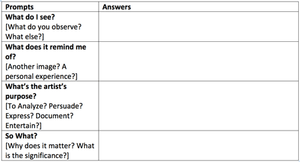
Request the iv Ws:Inspired by Debbie Abilock'south NoodleTools exercises, I adult the 4 Ws activeness to help students make observations, connections, and inferences about an creative person's agenda and develop ideas near a piece of work's significance:
5 Card Flickr:In Five Menu Flickr, players are dealt v random photos. To promote VL, have students follow these steps:
- Jot down one word that they associate with each prototype.
- Identify a song that comes to listen for one or more of the images.
- Draw what all the images take in common.
- Compare answers with classmates.
During a subsequent discussion, ask students to testify what elements of the photograph prompted their responses.
Image analysis worksheets:To promote analysis of fundamental features specific to different formats, pick an appropriate tool from the National Archives:
- Photo Analysis
- Cartoon Analysis
- Movie Analysis
- Map Assay
- Poster Analysis
Step-by-Step: Working With Images That Affair
The post-obit lesson is partially based on Ann Watts Pailliotet's notion of deep viewing, a process that occurs in iii phases:
- Literal ascertainment
- Interpretation
- Evaluation/application
Recall the 1957 photograph of Elizabeth Eckford and Hazel Bryan? Eckford was one of the commencement African American students to attend the newly desegregated Piddling Rock High School. In the photo, you encounter her entering the schoolhouse grounds while a throng of white students, most prominently an enraged Hazel Bryan, jeer. The photograph was disseminated worldwide within a couple of days, uncorking new support for ceremonious rights.
video
Hither are the lesson procedures:
Literal observation phase: Requite students a hard copy of the Eckford and Bryan photograph. To help them internalize the image, tell them to study information technology for one infinitesimal before turning information technology over and doodling a version of it from retentivity. Adjacent, have students write what they find—what is pictured, how space used used, etc.—in a shared Google Doc.
Interpretation phase:Copy all the pupil-generated descriptions from the Google Doc, paste them into Tagxedo, and so project the resulting collaborative word cloud for the course to view. Invite students to translate the word cloud while periodically re-examining the photo. What are the about important words? Which words practise they have questions about? What other images are they reminded of, past or present? What letters are implicit and explicit? How did they analyze the photo? What do they sympathise at present that they didn't before? Then accept students help yous summarize the conversation.
Evaluation and application phase:Direct students to write about the image'south relevance on notecards. Does the implied purpose of the photograph convey ideas that are important? How? Is the epitome biased? How so? Accept the postcards and pivot them around the Eckford and Bryan photo to create an instant bulletin lath.
To extend the lesson, show the following six-minute video, which narrates how Bryan, as a xx-twelvemonth-old, apologized in person to Eckford. The video features a contemporary photograph of both women, mature now, arm in arm, smiling in front end of the once infamous Little Rock High School. Ask students: Does the video alter your reactions to the original epitome? How? Will y'all approach other socially charged photos differently? Why?
Final Frame
When reading was taught the traditional style, with printed texts, students accepted the dominance of the writer and received his or her message as a window on reality. In the 21st century, students demand to respectfully question the author's potency, clear what is represented and how, and infer what has been excluded and why.
Source: https://www.edutopia.org/blog/ccia-10-visual-literacy-strategies-todd-finley
0 Response to "Common Core Art Standards Creating What Is Meant by Contemporary Art Practice?"
Post a Comment