Eorganics Soothe Natural Redness Relief Cream for Rosacea Reviews
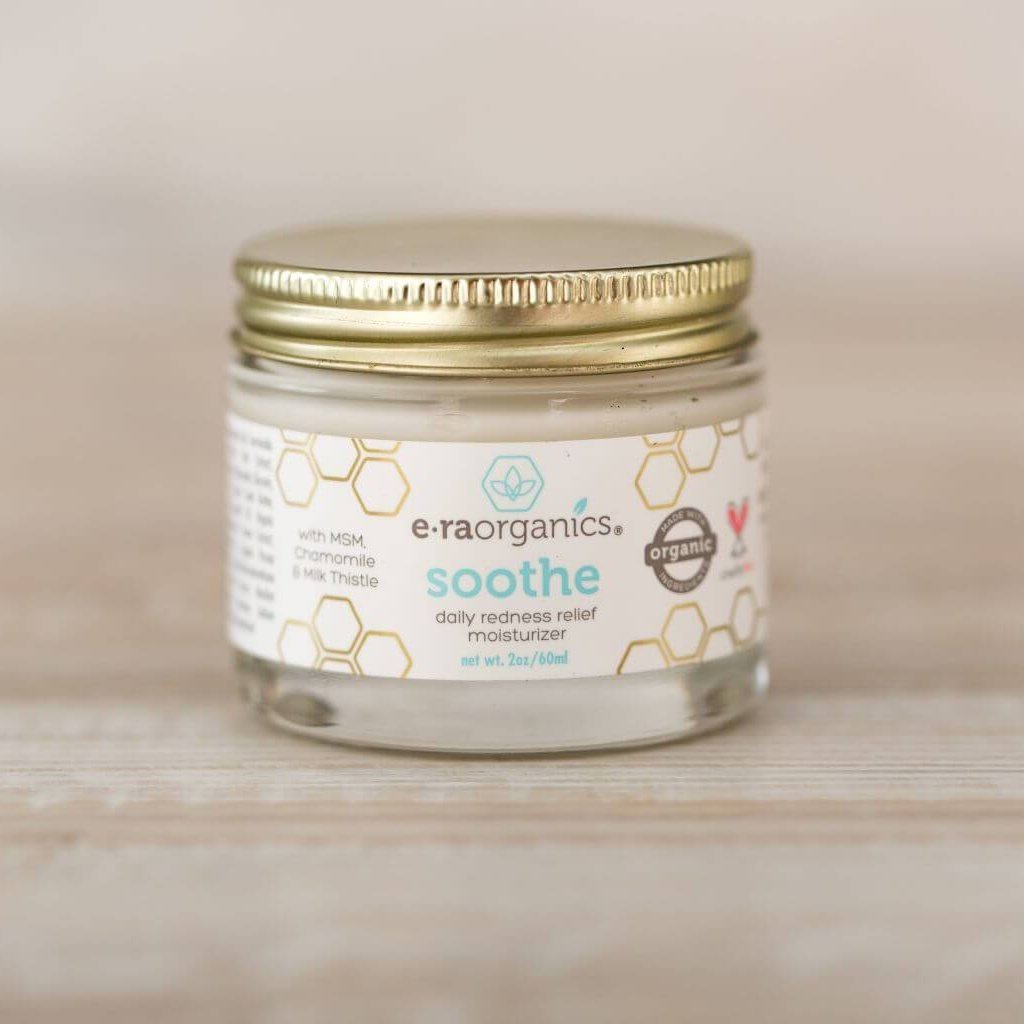
Soothe Natural Redness Relief Cream For Rosacea
Anti-Inflammatory Face Moisturizer Cream for Rosacea, Eczema, Acne, Dry out and Sensitive Skin.
Uploaded by: caroleena13 on
Ingredients overview
Aloe Barbadensis Gel-Organic, Terminalia Ferdinandiana (Kakadu Plum) Fruit Extract, Emulsifying Wax, Caprylic/Capric Triglyceride, Glycerine, Theobroma Cacao (Cocoa) Seed Butter, Cocos Nucifera (Coconut) Oil, Chamomilla Recutita (Matricaria) Blossom Extract-Organic, Retinol, Persea Gratissima (Avocado) Oil-Organic, Methyl Sulfonyl Methane, Milk Thistle Excerpt, Phenoxyethanol, Manihot Esculenta (Tapioca) Starch, Carbomer, Sodium Hydroxide, Titanium Dioxide
Highlights
Key Ingredients
Other Ingredients
Skim through
| Ingredient name | what-it-does | irr., com. | ID-Rating |
|---|---|---|---|
| Aloe Barbadensis Gel-Organic | soothing, moisturizer/humectant | goodie | |
| Terminalia Ferdinandiana (Kakadu Plum) Fruit Extract | antioxidant, pare brightening | ||
| Emulsifying Wax | emulsifying | ||
| Caprylic/Capric Triglyceride | emollient | ||
| Glycerine | peel-identical ingredient, moisturizer/humectant | 0, 0 | superstar |
| Theobroma Cacao (Cocoa) Seed Butter | emollient | 0, 4 | goodie |
| Cocos Nucifera (Coconut) Oil | emollient, perfuming | 0, 4 | goodie |
| Chamomilla Recutita (Matricaria) Flower Extract-Organic | soothing, antioxidant | 0, 0 | goodie |
| Retinol | cell-communicating ingredient | superstar | |
| Persea Gratissima (Avocado) Oil-Organic | antioxidant, emollient | 0, 0-three | goodie |
| Methyl Sulfonyl Methane | solvent, viscosity decision-making | ||
| Milk Thistle Extract | antioxidant, soothing | goodie | |
| Phenoxyethanol | preservative | ||
| Manihot Esculenta (Tapioca) Starch | viscosity controlling | ||
| Carbomer | viscosity controlling | 0, one | |
| Sodium Hydroxide | buffering | ||
| Titanium Dioxide | sunscreen, colorant | goodie |
Era Organics Soothe Natural Redness Relief Cream For Rosacea
Ingredients explainedAloe Vera is i of today's magic plants. Information technology does have some very prissy backdrop indeed, though famous dermatologist Leslie Baumann warns us in her volume that nearly of the evidence is anecdotal and the plant might be a bit overhyped.
What research does confirm about Aloe is that information technology'due south a great moisturizer and has several anti-inflammatory (amongst others contains salicylates, polysaccharides, magnesium lactate and C-glucosyl chromone) as well as some antibacterial components. It likewise helps wound healing and skin regeneration in general. All in all definitely a goodie.
 Nosotros don't take description for this ingredient nevertheless.
This ingredient name is not according to the INCI-standard. :( What, why?!
Probably refers to the emulsifier duo of Cetearyl Alcohol (and) Polysorbate 60. Helps oil and water to mix together.
A super common emollient that makes your peel feel overnice and polish. Information technology comes from coconut oil and glycerin, it's calorie-free-textured, clear, odorless and non-greasy. Information technology's a nice ingredient that just feels adept on the skin, is super well tolerated past every pare type and easy to codify with. No wonder it'due south popular.
- A natural moisturizer that's also in our skin
- A super mutual, safe, effective and inexpensive molecule used for more than 50 years
- Non only a elementary moisturizer but knows much more: keeps the peel lipids between our skin cells in a healthy (liquid crystal) state, protects confronting irritation, helps to restore barrier
- Effective from as low as iii% with fifty-fifty more benefits at college concentrations up to 20-40% (around 10% is a skillful usability-effectiveness sweetness spot)
- High-glycerin moisturizers are awesome for treating severely dry skin
Read all the geeky details about Glycerin here >>
Also-called: Cocoa Seed Butter | What-information technology-does: emollient | Irritancy: 0 | Comedogenicity: four
Theobroma means "nutrient of the gods" in Greek though probably "treat of the people" would exist more spot on. The cacao fruits and especially the seeds in it need no introduction every bit everyone knows them as the magical raw textile of the magical sweetness care for, chocolate (the flavour is composed of more than 1200(!) substances, and the exact chemic nature of information technology is not actually understood, so information technology's indeed magic. :)).
Every bit for skincare, cocoa butter counts as a rich emollient that can moisturize and nourish even the driest skin (think chapped easily or lips). Information technology's solid at room temperature and melts nicely when you smear it on. It'due south loaded with good-for-the-skin things: it contains fat acids, mainly oleic (35%), stearic (34%), and palmitic (25%) and it also has antioxidant vitamin Eastward and polyphenols.
An ex-vivo (made on homo skin but non on real people) report examined the cocoa polyphenols and establish that 0.5-0.75% of them improved skin tone and elasticity and had a similarly positive affect on GAGs (important natural moisturizing factors in the skin) and collagen synthesis than a commercial high-end moisturizer (it was an Estee Lauder i).
All in all, cocoa butter is a goodie, especially for very dry pare.
Also-called: Coconut Oil | What-it-does: emollient, perfuming | Irritancy: 0
There is definitely some craze going on for coconut oil both in the good for you eating space (ofttimes claimed to be the healthiest oil to melt with merely this is a topic for another site) and in the skin and hair care infinite.
Nosotros will talk here about the latter 2 and encounter why we might want to smear information technology all over ourselves. Chemically speaking, kokosnoot oil has a unique fatty acrid profile. Unlike many plant oils that by and large contain unsaturated fatty acids (fat acids with double bonds and kinky structure such equally linoleic or oleic), coconut oil is mostly saturated (fatty acids with single bonds only) and its nigh important fat acid is Lauric Acid (about 50%). Saturated fat acids have a linear construction that can stack nice and tight and hence they are unremarkably solid at room temperature. Kokosnoot oil melts effectually 25 °C so it is solid in the tub but melts on contact with the skin.
The saturated nature of coconut oil too means that it is a heavy-duty-oil ideal for dry skin types. A double-bullheaded research confirmed that extra virgin coconut oil is as constructive in treating xerosis (aka very dry pare) equally mineral oil. Another study institute that coconut oil is more effective than mineral oil in treating mild to moderate atopic dermatitis (aka eczema) in children.
And then when information technology comes to dry pare, coconut oil is a goodie, no question there. The question is if it is good or bad for acne-prone skin. Its main fatty acid, Lauric Acid has some research showing that it is a promising ingredient against evil acne-causing bacteria, P. acnes but at the same fourth dimension, both Lauric Acid and kokosnoot oil have a very loftier comedogenic rating (4 out of 5). Though comedogenic ratings are not very reliable, anecdotal prove (i.due east. people commenting in forums) shows that people accept mixed experiences. While some claim that it worked wonders on their acne others say that it gave them serious blackheads and zits. Try it at your own risk.
Equally for hair care, kokosnoot oil has pretty solid enquiry showing that it tin penetrate into the pilus very well (better than mineral oil and sunflower oil) and it tin prevent pilus protein loss also as combing harm. If yous have problems with damaged hair, separate ends, coconut oil is worth trying equally a pre- or/and postal service-wash treatment. Labmuffin has an awesome blogpost explaining in more detail why coconut oil is adept for your hair.
A couple of other things worth mentioning: coconut oil might help with wound healing (promising brute study), it has some antifungal activity (against dermatophytes that crusade the thing known every bit ringworm) and information technology also works as an insect repellent against blackness flies.
Overall, coconut oil is definitely a goodie for the hair and dry pare. If that warrants for the magic oil status it enjoys, nosotros don't know.
Too-called: High german Chamomile Flower Extract;Chamomilla Recutita Flower Excerpt | What-it-does: soothing, antioxidant | Irritancy: 0
Chamomile probably needs no introduction every bit it's 1 of the almost widely used medicinal herbs. You probably drink it regularly equally a prissy, calming cup of tea and it's as well a regular on skincare ingredient lists.
Cosmetic companies utilize it mainly for its anti-inflammatory properties. It contains the terpenoids chamazulene and bisabolol both of which show corking anti-inflammatory action in animal studies. On superlative of that chamomile also has some antioxidant activity (thanks to some other active ingredients chosen matricine, apigenin and luteolin).
Though chamomile is usually a goodie for the skin, it's as well not uncommon to take an allergic reaction to it.
- Retinol (pure Vitamin A) is probably the nearly proven anti-crumbling ingredient available OTC
- It has to be converted in the skin to retinoic acid to piece of work its magic
- Once converted, it has the same result as all-trans-retinoic acid, aka tretinoin
- A generally accustomed ballpark number is that retinol is ten-to-xx times less potent than retinoic acid
- Information technology makes skin less wrinkled, smoother, firmer and tighter
- It might besides exist helpful for acne decumbent skin as information technology normalizes keratinization and makes the pores produce less sebum
- Possible side effects and irritation are besides much less than with retinoic acrid
- Practice non apply whilst pregnant
Read all the geeky details most Retinol here >>
Also-called: Avocado Oil, Persea Americana Oil;Persea Gratissima Oil | What-it-does: antioxidant, emollient | Irritancy: 0 | Comedogenicity: 0-3
The oil coming from the pulp of one of the well-nigh nutritious fruits in the earth, the avocado. It'due south loaded with thenourishing and moisturizing fatty acrid, oleic (lxx%) and contains some others including palmitic (ten%) and linoleic acrid (8%). It also contains a bunch of minerals and vitamins A, E and D.
Avocado oil has extraordinary peel penetration abilities and can attend different skin layers. It'south a very rich, highly moisturizing emollient oil that makes the skin smooth and nourished. Thanks to its vitamin E content it too has some antioxidant properties. As a high-oleic plant oil, it is recommended for dry skin.
We don't have description for this ingredient yet.
Also-called: Lady's Thistle Extract;Silybum Marianum Extract | What-it-does: antioxidant, soothing
The extract of a found with dainty purple flowers that's loaded with the phytochemical calledsilymarin. Yous have probably never heard of silymarin simply let the states tell you it's a pretty awesome ingredient.
In that location are quite a lot of inquiry showing it tin do all kinds of skillful things when taken orally: it has a proven ability to protect you lot from liver impairment, and information technology too shows powerful antioxidant, anticarcinogenic, protective and regenerative properties with no more side effects than placebo.
Simply what well-nigh skincare? Well, in that location is less research most its topical use but it definitely deserves the goodie status: it's a potent antioxidant, an anti-inflammatory amanuensis and it's also a great UV-protectant. It'southward useful as a complementary handling for rosacea, keeping the skin hydrated and information technology's also a super nice addition to any sunscreen product thanks to its unique UV-protecting abilities.
It'southward pretty much the current IT-preservative. It's safe and gentle, merely fifty-fifty more importantly, it's not a feared-by-everyone-more often than not-without-scientific-reason paraben.
Information technology's not something new: it was introduced effectually 1950 and today information technology can be used upwardly to 1% worldwide. Information technology can exist found in nature - in light-green tea - only the version used in cosmetics is synthetic.
Other than having a adept safety profile and being quite gentle to the peel information technology has some other advantages too. It tin be used in many types of formulations as it has cracking thermal stability (tin can exist heated upwards to 85°C) and works on a wide range of pH levels (ph iii-10).
It's oftentimes used together with ethylhexylglycerin equally it nicely improves the preservative activeness of phenoxyethanol.
A soft, white pulverization that tin exist used as a talc replacement in body powders or in pressed powders. Information technology too has some oil absorbing properties and gives increased absorber and richness to emulsion-type formulas.
A large molecule created from repeated subunits (a polymer of acrylic acrid) that magically converts a liquid into a nice gel formula. It usually has to exist neutralized with a base of operations (such as sodium hydroxide) for the thickening to occur and information technology creates gluey, clear gels that also feel nice and not-tacky on the pare. No wonder, it is a very popular and common ingredient. Typically used at 1% or less in about formulations.
Also-called: lye | What-information technology-does: buffering
The unfancy name for it is lye. It's a solid white stuff that'south very alkaline and used in small-scale amounts to adjust the pH of the production and make it just right.
For example, in example of AHA or BHA exfoliants, the right pH is super-duper important, and pH adjusters similar sodium hydroxide are needed.
BTW, lye is not something new. It was already used past ancient Egyptians to assist oil and fat magically plough into something else. Can you gauge what? Yes, information technology's soap. It still oft shows upwardly in the ingredient list of soaps and other cleansers.
Sodium hydroxide in itself is a strong peel irritant, but one time it'southward reacted (as information technology is usually in pare care products, like exfoliants) it is totally harmless.
Titanium Dioxide is one of the two members of the elite sunscreen grouping called physical sunscreens (or inorganic sunscreens if you're a science geek and desire to exist precise).
Traditionally, UV-filters are categorized as either chemical or physical. The big departure is supposed to be that chemical agents blot UV-low-cal while physical agents reflect it similar a bunch of mini umbrellas on acme of the skin. While this categorization is easy and logical it turns out it's non true. A recent, 2016 study shows that inorganic sunscreens work mostly past absorption, just like chemical filters, and only a little bit by reflection (they exercise reflect the light in the visible spectrum, but generally absorb in the UV spectrum).
Anyway, it doesn't matter if it reflects or absorbs, Titanium Dioxide is a pretty crawly sunscreen amanuensis for two principal reasons: it gives a squeamish wide spectrum coverage and it's highly stable. Its protection is very good between 290 - 350 nm (UVB and UVA Two range), and less skilful at 350-400 nm (UVA I) range. Regular sized Titanium Dioxide too has a bully safety profile, it's not-irritating and is pretty much free from any health concerns (like estrogenic effect worries with some chemical filters).
The disadvantage of Titanium Dioxide is that it'due south non cosmetically elegant, meaning it'due south a white, "unspreadable" mess. Sunscreens containingTitanium Dioxide are often hard to spread on the pare and they leave a disturbing whitish tint. The corrective industry is, of course, really trying to solve this problem and the all-time solution then far is using nanoparticles. The itsy-bitsy Nano-sized particles improve both spreadability and reduce the whitish tint a lot, but unfortunately, information technology also introduces new wellness concerns.
The main concern with nanoparticles is that they are so tiny that they are absorbed into the skin more than we want them (ideally sunscreen should remain on the surface of the skin). One time absorbed they might form unwanted complexes with proteins and they might promote the formation of evil free radicals. Merely do not panic, these are concerns under investigation. A 2009 review commodity nigh the safety of nanoparticles summarizes this, "to date, in-vivo and in-vitro studies have non demonstrated percutaneous penetration of nanosized particles in titanium dioxide and zinc oxide sunscreens". The English language translation is, so far it looks similar sunscreens with nanoparticles do stay on the surface of the skin where they should be.
All in all, Titanium Dioxide is a famous sunscreen agent and for good reason, it gives broad spectrum UV protection (best at UVB and UVA Ii), it's highly stable, and it has a good safety profile. It's definitely one of the best UV-filter agents we have today, especially in the US where new-generation Tinosorb filters are non (yet) approved.
You may too desire to take a expect at...
The famous aloe vera. A bully moisturizer and anti-inflammatory ingredient that also helps wound healing and skin regeneration. [more than] Probably refers to the emulsifier duo of Cetearyl Alcohol (and) Polysorbate 60. Helps oil and water to mix together. [more] A very common emollient that makes your skin feel nice and smooth. Comes from coconut oil and glycerin, it's calorie-free-textured, clear, odorless and non-greasy. [more] A real oldie but a goodie. Corking natural moisturizer and skin-identical ingredient that plays an important role in pare hydration and general pare wellness. [more] Cocoa Butter - a rich emollient that can moisturize and nourish even the driest peel. Contains fatty acids (mainly oleic - 35%, stearic - 34%, and palmitic - 25%), antioxidant vitamin E and polyphenols. [more than] There is definitely some craze going on for coconut oil both in the healthy eating infinite (often claimed to be the healthiest oil to melt with but this is a topic for another site) and in the skin and hair care infinite. Nosotros will talk here most the latter two and see why we might desire to smear it all over ourselves. [more] Vitamin A - the most proven anti-aging ingredient available OTC that can smooth wrinkles and make peel firmer. It might as well be useful for acne-prone skin equally it normalizes keratinization. [more] Avocado oil - a highly moisturizing, rich emollient oil that is loaded with fat acids (oleic - 70%) and vitamin A, Due east and D. [more] Pretty much the electric current It-preservative. Information technology's safe and gentle, and tin be used up to 1% worldwide. [more] A soft, white pulverization that can be used as a talc replacement in torso powders or in pressed powders. It besides has some oil arresting backdrop and gives increased cushion and richness to emulsion-type formulas. A handy white powder that magically converts a liquid into a dainty gel formula. [more] Lye - A solid white stuff that'south very alkaline and used in small amount to adjust the pH of the production. [more] A physical/inorganic sunscreen with pretty broad spectrum (UVB and UVA Ii, less good at UVA I) protection and good stability. Might leave some whitish tint on the skin, though. [more than]
Source: https://incidecoder.com/products/era-organics-soothe-natural-redness-relief-cream-for-rosacea
0 Response to "Eorganics Soothe Natural Redness Relief Cream for Rosacea Reviews"
Post a Comment