What is Watsons reaction to discovering this information?
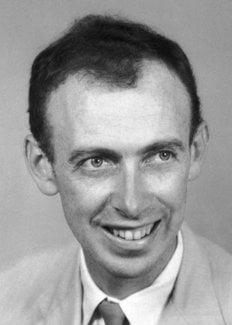 J ames Dewey Watson was built-in in Chicago, Ill., on April 6th, 1928, as the only son of James D. Watson, a businessman, and Jean Mitchell. His father's ancestors were originally of English descent and had lived in the midwest for several generations. His female parent'southward father was a Scottish-built-in tailor married to a girl of Irish immigrants who arrived in the U.s.a. about 1840. Immature Watson's unabridged boyhood was spent in Chicago where he attended for eight years Horace Mann Grammar School and for ii years South Shore High School. He and so received a tuition scholarship to the University of Chicago, and in the summertime of 1943 entered their experimental iv-twelvemonth college.
In 1947, he received a B.Sc. caste in Zoology. During these years his adolescence interest in bird-watching had matured into a serious desire to learn genetics. This became possible when he received a Fellowship for graduate written report in Zoology at Indiana Academy in Bloomington, where he received his Ph.D. caste in Zoology in 1950. At Indiana, he was deeply influenced both by the geneticists H. J. Muller and T. Thou. Sonneborn, and by S. E. Luria, the Italian-born microbiologist then on the staff of Indiana's Bacteriology Department. Watson's Ph.D. thesis, done under Luria's able guidance, was a study of the effect of hard Ten-rays on bacteriophage multiplication.
From September 1950 to September 1951 he spent his showtime postdoctoral year in Copenhagen as a Merck Fellow of the National Enquiry Council. Part of the twelvemonth was spent with the biochemist Herman Kalckar, the remainder with the microbiologist Ole Maaløe. Over again he worked with bacterial viruses, attempting to report the fate of DNA of infecting virus particles. During the leap of 1951, he went with Kalckar to the Zoological Station at Naples. At that place at a Symposium, tardily in May, he met Maurice Wilkins and saw for the outset fourth dimension the 10-ray diffraction pattern of crystalline Dna. This profoundly stimulated him to alter the direction of his research toward the structural chemical science of nucleic acids and proteins. Fortunately this proved possible when Luria, in early August 1951, arranged with John Kendrew for him to work at the Cavendish Laboratory, where he started piece of work in early October 1951.
He soon met Crick and discovered their common interest in solving the Deoxyribonucleic acid structure. They thought it should exist possible to correctly approximate its structure, given both the experimental evidence at Rex's College plus careful test of the possible stereochemical configurations of polynucleotide bondage. Their first serious effort, in the late fall of 1951, was unsatisfactory. Their second effort based upon more experimental prove and better appreciation of the nucleic acid literature, resulted, early in March 1953, in the proposal of the complementary double-helical configuration.
At the same time, he was experimentally investigating the construction of TMV, using X-ray diffraction techniques. His object was to encounter if its chemical sub-units, before revealed by the elegant experiments of Schramm, were helically arranged. This objective was achieved in tardily June 1952, when employ of the Cavendish's newly constructed rotating anode 10-ray tubes allowed an unambiguous demonstration of the helical structure of the virus.
From 1953 to 1955, Watson was at the California Institute of Technology as Senior Research Fellow in Biology. There he collaborated with Alexander Rich in Ten-ray diffraction studies of RNA. In 1955-1956 he was back in the Cavendish, once again working with Crick. During this visit they published several papers on the full general principles of virus structure.
Since the fall of 1956, he has been a member of the Harvard Biological science Department, outset as Assistant Professor, so in 1958 as an Acquaintance Professor, and as Professor since 1961. During this interval, his major research involvement has been the office of RNA in protein synthesis. Among his collaborators during this period were the Swiss biochemist Alfred Tissières and the French biochemist François Gros. Much experimental evidence supporting the messenger RNA concept was accumulated. His present principal collaborator is the theoretical physicist Walter Gilbert who, as Watson expressed it, «has recently learned the excitement of experimental molecular biological science».
The honours that have to come up to Watson include: the John Collins Warren Prize of the Massachusetts General Infirmary, with Crick in 1959; the Eli Lilly Accolade in Biochemistry in the same twelvemonth; the Lasker Award, with Crick and Wilkins in 1960; the Research Corporation Prize, with Crick in 1962; membership of the American University of Arts and Sciences and the National University of Sciences, and Foreign membership of the Danish Academy of Arts and Sciences. He is also a consultant to the President'south Scientific Advisory Committee.
Watson is unmarried. His recreations are bird-watching and walking.
This autobiography/biography was written at the time of the honor and starting time published in the book series Les Prix Nobel. It was after edited and republished in Nobel Lectures. To cite this certificate, always state the source as shown above.
For more than updated biographical information, come across:
Watson, J.D., The Double Helix. Atheneum, New York, 1968.
Dorsum to top
Nobel Prizes 2021
Xiii laureates were awarded a Nobel Prize in 2021, for achievements that take conferred the greatest benefit to humankind.
Their work and discoveries range from the Earth'due south climate and our sense of bear on to efforts to safeguard liberty of expression.
See them all presented here.


Source: https://www.nobelprize.org/prizes/medicine/1962/watson/biographical/
0 Response to "What is Watsons reaction to discovering this information?"
Post a Comment