what did the scientist say to the hydrogen atom that claimed to have lost an electron
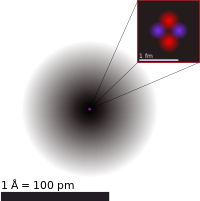
The current theoretical model of the atom involves a dumbo nucleus surrounded by a probabilistic "cloud" of electrons
Atomic theory is the scientific theory that matter is composed of particles called atoms. Atomic theory traces its origins to an aboriginal philosophical tradition known as atomism. According to this thought, if i were to have a lump of matter and cut it into always smaller pieces, ane would somewhen reach a point where the pieces could not exist further cut into anything smaller. Ancient Greek philosophers called these hypothetical ultimate particles of matter atomos, a word which meant "uncut".
In the early 1800s, the scientist John Dalton noticed that chemical substances seemed to combine and intermission down into other substances past weight in proportions that suggested that each element is ultimately made up of tiny indivisible particles of consistent weight. Soon later 1850, certain physicists developed the kinetic theory of gases and of heat, which mathematically modelled the behavior of gases by assuming that they were made of particles. In the early on 20th century, Albert Einstein and Jean Perrin proved that Brownian motion (the erratic motion of pollen grains in water) is caused past the activity of h2o molecules; this tertiary line of evidence silenced remaining doubts among scientists as to whether atoms and molecules were existent. Throughout the nineteenth century, some scientists had cautioned that the evidence for atoms was indirect, and therefore atoms might not actually exist real, simply just seem to be real.
Past the early 20th century, scientists had developed adequately detailed and precise models for the construction of matter, which led to more rigorously-defined classifications for the tiny invisible particles that make up ordinary matter. An atom is now defined equally the basic particle that composes a chemical element. Around the plough of the 20th century, physicists discovered that the particles that chemists chosen "atoms" are in fact agglomerations of even smaller particles (subatomic particles), but scientists kept the name out of convention. The term elementary particle is now used to refer to particles that are really indivisible.
History
Philosophical atomism
The idea that matter is made up of discrete units is a very old idea, appearing in many ancient cultures such as Hellenic republic and India. The discussion "atom" (Greek: ἄτομος ; atomos ), meaning "uncuttable", was coined by the Pre-Socratic Greek philosophers Leucippus and his pupil Democritus (c.460–c.370 BC).[1] [two] [three] [4] Democritus taught that atoms were infinite in number, uncreated, and eternal, and that the qualities of an object result from the kind of atoms that compose information technology.[2] [3] [4] Democritus's atomism was refined and elaborated by the after Greek philosopher Epicurus (341–270 BC), and past the Roman Gluttonous poet Lucretius (c.99–c.55 BC).[3] [4] During the Early on Heart Ages, atomism was mostly forgotten in western Europe. During the 12th century, it became known once more in western Europe through references to it in the newly-rediscovered writings of Aristotle.[3] The opposing view of matter upheld by Aristotle was that matter was continuous and infinite and could be subdivided without limit.[5] [6]
In the 14th century, the rediscovery of major works describing atomist teachings, including Lucretius'southward De rerum natura and Diogenes Laërtius's Lives and Opinions of Eminent Philosophers, led to increased scholarly attention on the subject. However, because atomism was associated with the philosophy of Epicureanism, which contradicted orthodox Christian teachings, conventionalities in atoms was not considered acceptable past most European philosophers.[three] The French Catholic priest Pierre Gassendi (1592–1655) revived Epicurean atomism with modifications, arguing that atoms were created past God and, though extremely numerous, are not space. He was the outset person who used the term "molecule" to draw aggregation of atoms.[3] [4] Gassendi'due south modified theory of atoms was popularized in France by the physician François Bernier (1620–1688) and in England by the natural philosopher Walter Charleton (1619–1707). The pharmacist Robert Boyle (1627–1691) and the physicist Isaac Newton (1642–1727) both dedicated atomism and, by the end of the 17th century, it had become accepted by portions of the scientific community.[3]
John Dalton
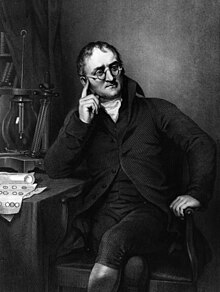
Virtually the end of the 18th century, 2 laws about chemical reactions emerged without referring to the notion of an atomic theory. The first was the law of conservation of mass, closely associated with the work of Antoine Lavoisier, which states that the full mass in a chemical reaction remains constant (that is, the reactants have the same mass every bit the products).[7] The 2nd was the law of definite proportions. Kickoff established by the French chemist Joseph Proust in 1797 this police states that if a compound is broken downward into its elective chemic elements, then the masses of the constituents will e'er take the same proportions by weight, regardless of the quantity or source of the original substance.[8]
John Dalton studied and expanded upon this previous work and dedicated a new idea, later known as the law of multiple proportions: if the same ii elements can be combined to grade a number of different compounds, then the ratios of the masses of the ii elements in their various compounds will exist represented by small whole numbers. This is a common pattern in chemic reactions that was observed by Dalton and other chemists at the time.
Case i — tin oxides: Dalton identified two oxides of tin can. One is a grey powder in which for every 100 parts of tin there is thirteen.five parts of oxygen. The other oxide is a white powder in which for every 100 parts of tin in that location is 27 parts of oxygen.[9] 13.5 and 27 form a ratio of 1:two. These oxides are today known every bit tin(Two) oxide (SnO) and tin(Four) oxide (SnO2) respectively.
Instance ii — iron oxides: Dalton identified two oxides of fe. One is a blackness powder in which for every 100 parts of atomic number 26 there is most 28 parts of oxygen. The other is a red powder in which for every 100 parts of iron there is 42 parts of oxygen.[10] 28 and 42 course a ratio of 2:three. These oxides are today known as atomic number 26(II) oxide (better known as wüstite) and atomic number 26(III) oxide (the major constituent of rust). Their formulas are FeO and FetwoOiii respectively.
Example iii — nitrogen oxides: There are three oxides of nitrogen in which for every 140 m of nitrogen, there is 80 g, 160 chiliad, and 320 yard of oxygen respectively, which gives a ratio of 1:2:4. These are nitrous oxide (N2O), nitric oxide (NO), and nitrogen dioxide (NO2) respectively.
This recurring pattern suggested that chemicals practice non react in any arbitrary quantity, just in multiples of some basic indivisible unit of mass.
In his writings, Dalton used the term "atom" to refer to the basic particle of any chemical substance, not strictly for elements equally is the practice today. Dalton did non use the word "molecule"; instead, he used the terms "chemical compound atom" and "elementary atom".[eleven] Dalton proposed that each chemical element is composed of atoms of a single, unique type, and though they cannot be altered or destroyed by chemic means, they tin combine to form more circuitous structures (chemical compounds). This marked the first truly scientific theory of the cantlet, since Dalton reached his conclusions by experimentation and test of the results in an empirical style.
In 1803 Dalton referred to a list of relative atomic weights for a number of substances in a talk before the Manchester Literary and Philosophical Society on the solubility of various gases, such as carbon dioxide and nitrogen, in water. Dalton did not indicate how he obtained the relative weights, merely he initially hypothesized that variation in solubility was due to differences in mass and complication of the gas particles – an thought that he abandoned by the time the newspaper was finally published in 1805.[12] Over the years, several historians have attributed the evolution of Dalton's atomic theory to his written report of gaseous solubility, simply a contempo study of his laboratory notebook entries concludes he adult the chemical atomic theory in 1803 to reconcile Cavendish's and Lavoisier's analytical data on the limerick of nitric acid, not to explicate the solubility of gases in h2o.[13]
Thomas Thomson published the start brief business relationship of Dalton's atomic theory in the third edition of his volume, A Organisation of Chemistry.[xiv] In 1808 Dalton published a fuller business relationship in the first role of A New System of Chemic Philosophy.[15] However, information technology was not until 1811 that Dalton provided his rationale for his theory of multiple proportions.[16]
Dalton estimated the diminutive weights according to the mass ratios in which they combined, with the hydrogen atom taken as unity. However, Dalton did not conceive that with some elements atoms be in molecules—due east.g. pure oxygen exists as Otwo. He also mistakenly believed that the simplest compound between any two elements is always one atom of each (so he idea h2o was HO, not H2O).[17] This, in addition to the crudity of his equipment, flawed his results. For instance, in 1803 he believed that oxygen atoms were 5.5 times heavier than hydrogen atoms, because in water he measured v.5 grams of oxygen for every 1 gram of hydrogen and believed the formula for water was HO. Adopting better information, in 1806 he concluded that the atomic weight of oxygen must really exist vii rather than five.5, and he retained this weight for the rest of his life. Others at this fourth dimension had already concluded that the oxygen cantlet must weigh 8 relative to hydrogen equals 1, if ane assumes Dalton's formula for the water molecule (HO), or 16 if one assumes the modern h2o formula (H2O).[xviii]
Avogadro
The flaw in Dalton'due south theory was corrected in principle in 1811 past Amedeo Avogadro. Avogadro had proposed that equal volumes of whatsoever two gases, at equal temperature and pressure, comprise equal numbers of molecules (in other words, the mass of a gas's particles does non bear upon the volume that it occupies).[nineteen] Avogadro'due south law immune him to deduce the diatomic nature of numerous gases by studying the volumes at which they reacted. For instance: since 2 liters of hydrogen volition react with simply one liter of oxygen to produce 2 liters of water vapor (at abiding pressure and temperature), information technology meant a single oxygen molecule splits in two in order to form two particles of water. Thus, Avogadro was able to offering more accurate estimates of the diminutive mass of oxygen and diverse other elements, and made a clear distinction between molecules and atoms.
Brownian Motion
In 1827, the British botanist Robert Dark-brown observed that dust particles within pollen grains floating in water constantly jiggled about for no apparent reason. In 1905, Albert Einstein theorized that this Brownian motion was acquired by the water molecules continuously knocking the grains about, and developed a hypothetical mathematical model to draw it.[xx] This model was validated experimentally in 1908 past French physicist Jean Perrin, thus providing additional validation for particle theory (and by extension atomic theory).
Statistical Mechanics
In social club to introduce the Platonic gas law and statistical forms of physics, it was necessary to postulate the existence of atoms. In 1738, Swiss physicist and mathematician Daniel Bernoulli postulated that the force per unit area of gases and heat were both caused by the underlying motion of molecules.
In 1860, James Clerk Maxwell, who was a song proponent of atomism, was the start to use statistical mechanics in physics.[21] Ludwig Boltzmann and Rudolf Clausius expanded his work on gases and the laws of Thermodynamics especially the 2d police relating to entropy. In the 1870s, Josiah Willard Gibbs, sometimes referred to as America's greatest physicist,[22] extended the laws of entropy and thermodynamics and coined the term "statistical mechanics." Einstein later independently reinvented Gibb's laws, considering they had only been printed in an obscure American journal.[23] Einstein after commented, had he known of Gibb'south work he would "non have published those papers at all, but bars myself to the handling of some few points [that were singled-out]."[24] All of statistical mechanics and the laws of rut, gas, and entropy were necessarily postulated upon the existence of atoms.
Discovery of subatomic particles


The cathode rays (blue) were emitted from the cathode, sharpened to a beam past the slits, then deflected as they passed betwixt the two electrified plates.
Atoms were thought to be the smallest possible division of affair until 1897 when J. J. Thomson discovered the electron through his piece of work on cathode rays.[25]
A Crookes tube is a sealed glass container in which two electrodes are separated by a vacuum. When a voltage is applied across the electrodes, cathode rays are generated, creating a glowing patch where they strike the glass at the opposite end of the tube. Through experimentation, Thomson discovered that the rays could be deflected by an electrical field (in addition to magnetic fields, which was already known). He concluded that these rays, rather than being a class of light, were composed of very low-cal negatively charged particles he called "corpuscles" (they would afterward exist renamed electrons by other scientists). He measured the mass-to-charge ratio and discovered it was 1800 times smaller than that of hydrogen, the smallest atom. These corpuscles were a particle unlike any other previously known.
Thomson suggested that atoms were divisible, and that the corpuscles were their building blocks.[26] To explain the overall neutral charge of the atom, he proposed that the corpuscles were distributed in a uniform bounding main of positive charge; this was the plum pudding model[27] every bit the electrons were embedded in the positive charge like raisins in a plum pudding (although in Thomson'due south model they were non stationary). The reason J.J. Thompson'south spherical positive charge model interspersed with negative electrons was virtually widely accustomed over several different versions of nuclear planetary models was that the Thompson model could best marshal with classical physics. Solar system models proposed before Thompson ever resulted in atoms spiraling into the nucleus.[28]
Discovery of the nucleus
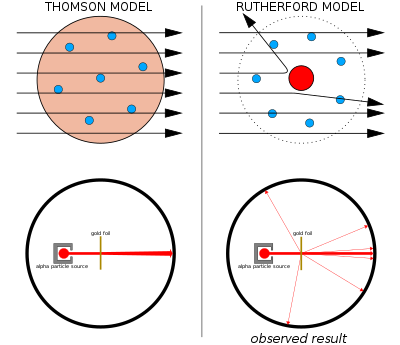
The Geiger–Marsden experiment
Left: Expected results: blastoff particles passing through the plum pudding model of the cantlet with negligible deflection.
Right: Observed results: a pocket-sized portion of the particles were deflected by the concentrated positive accuse of the nucleus.
Thomson's plum pudding model was disproved in 1909 past one of his former students, Ernest Rutherford, who discovered that most of the mass and positive charge of an atom is concentrated in a very small-scale fraction of its book, which he assumed to be at the very center.
Ernest Rutherford and his colleagues Hans Geiger and Ernest Marsden came to have doubts virtually the Thomson model after they encountered difficulties when they tried to build an instrument to measure out the charge-to-mass ratio of blastoff particles (these are positively-charged particles emitted by sure radioactive substances such as radium). The alpha particles were being scattered by the air in the detection chamber, which made the measurements unreliable. Thomson had encountered a similar trouble in his work on cathode rays, which he solved by creating a well-nigh-perfect vacuum in his instruments. Rutherford didn't think he'd run into this aforementioned problem because blastoff particles are much heavier than electrons. According to Thomson's model of the atom, the positive charge in the atom is not full-bodied enough to produce an electric field strong plenty to deflect an blastoff particle, and the electrons are so lightweight they should exist pushed bated effortlessly by the much heavier alpha particles. Even so there was scattering, and so Rutherford and his colleagues decided to investigate this handful carefully.[29]
Between 1908 and 1913, Rutherford and his colleagues performed a series of experiments in which they bombarded thin foils of metallic with alpha particles. They spotted alpha particles being deflected by angles greater than 90°. To explain this, Rutherford proposed that the positive accuse of the atom is not distributed throughout the atom's volume as Thomson believed, but is concentrated in a tiny nucleus at the center. Only such an intense concentration of charge could produce an electric field stiff plenty to deflect the alpha particles as observed.[29] Rutherford'southward model is sometimes called the "planetary model".[30] However, Hantaro Nagaoka was quoted past Rutherford as the first to advise a planetary atom in 1904.[31] And planetary models had been suggested as early every bit 1897 such as the i past Joseph Larmor.[32] Probably the primeval solar system model was found in an unpublished annotation by Ludwig August Colding in 1854 whose idea was that atoms were analogous to planetary systems that rotate and crusade magnetic polarity.[33]
First steps toward a breakthrough concrete model of the cantlet
The planetary model of the atom had 2 significant shortcomings. The showtime is that, unlike planets orbiting a dominicus, electrons are charged particles. An accelerating electric charge is known to emit electromagnetic waves according to the Larmor formula in classical electromagnetism. An orbiting charge should steadily lose energy and spiral toward the nucleus, colliding with it in a pocket-sized fraction of a 2d. The second problem was that the planetary model could non explicate the highly peaked emission and assimilation spectra of atoms that were observed.

Quantum theory revolutionized physics at the beginning of the 20th century, when Max Planck and Albert Einstein postulated that low-cal energy is emitted or absorbed in detached amounts known equally quanta (singular, quantum). This led to a series of quantum atomic models such as the quantum model of Arthur Erich Haas in 1910 and the 1912 John William Nicholson quantum diminutive model that quantized angular momentum as h/iiπ.[34] [35] In 1913, Niels Bohr incorporated this idea into his Bohr model of the atom, in which an electron could only orbit the nucleus in particular circular orbits with fixed athwart momentum and energy, its distance from the nucleus (i.eastward., their radii) being proportional to its energy.[36] Under this model an electron could non spiral into the nucleus considering it could not lose energy in a continuous way; instead, it could only make instantaneous "quantum leaps" betwixt the fixed free energy levels.[36] When this occurred, low-cal was emitted or absorbed at a frequency proportional to the modify in free energy (hence the absorption and emission of low-cal in detached spectra).[36]
Bohr's model was not perfect. It could but predict the spectral lines of hydrogen; it couldn't predict those of multielectron atoms. Worse still, as spectrographic technology improved, boosted spectral lines in hydrogen were observed which Bohr'southward model couldn't explain. In 1916, Arnold Sommerfeld added elliptical orbits to the Bohr model to explain the extra emission lines, but this made the model very hard to use, and information technology still couldn't explain more complex atoms.
Discovery of isotopes
While experimenting with the products of radioactivity, in 1913 radiochemist Frederick Soddy discovered that in that location appeared to be more than than one element at each position on the periodic table.[37] The term isotope was coined past Margaret Todd as a suitable name for these elements.
That same year, J. J. Thomson conducted an experiment in which he channeled a stream of neon ions through magnetic and electrical fields, striking a photographic plate at the other end. He observed two glowing patches on the plate, which suggested 2 dissimilar deflection trajectories. Thomson concluded this was because some of the neon ions had a different mass.[38] The nature of this differing mass would later be explained past the discovery of neutrons in 1932.
Discovery of nuclear particles
In 1917 Rutherford bombarded nitrogen gas with alpha particles and observed hydrogen nuclei being emitted from the gas (Rutherford recognized these, because he had previously obtained them bombarding hydrogen with alpha particles, and observing hydrogen nuclei in the products). Rutherford ended that the hydrogen nuclei emerged from the nuclei of the nitrogen atoms themselves (in effect, he had split a nitrogen).[39]
From his own work and the work of his students Bohr and Henry Moseley, Rutherford knew that the positive charge of any atom could always be equated to that of an integer number of hydrogen nuclei. This, coupled with the diminutive mass of many elements being roughly equivalent to an integer number of hydrogen atoms - then causeless to be the lightest particles - led him to conclude that hydrogen nuclei were atypical particles and a basic constituent of all atomic nuclei. He named such particles protons. Further experimentation past Rutherford constitute that the nuclear mass of most atoms exceeded that of the protons it possessed; he speculated that this surplus mass was equanimous of previously-unknown neutrally charged particles, which were tentatively dubbed "neutrons".
In 1928, Walter Bothe observed that beryllium emitted a highly penetrating, electrically neutral radiation when bombarded with alpha particles. Information technology was later discovered that this radiation could knock hydrogen atoms out of paraffin wax. Initially information technology was thought to be high-energy gamma radiations, since gamma radiation had a similar event on electrons in metals, just James Chadwick found that the ionization effect was likewise strong for information technology to be due to electromagnetic radiation, then long as energy and momentum were conserved in the interaction. In 1932, Chadwick exposed various elements, such equally hydrogen and nitrogen, to the mysterious "beryllium radiation", and by measuring the energies of the recoiling charged particles, he deduced that the radiation was actually composed of electrically neutral particles which could not exist massless like the gamma ray, but instead were required to take a mass like to that of a proton. Chadwick now claimed these particles as Rutherford's neutrons.[twoscore] For his discovery of the neutron, Chadwick received the Nobel Prize in 1935.
Breakthrough physical models of the atom

The five filled diminutive orbitals of a neon atom separated and bundled in order of increasing energy from left to right, with the concluding three orbitals being equal in free energy. Each orbital holds up to two electrons, which most probably exist in the zones represented by the colored bubbles. Each electron is equally present in both orbital zones, shown here past color only to highlight the dissimilar wave phase.
In 1924, Louis de Broglie proposed that all moving particles—particularly subatomic particles such every bit electrons—exhibit a caste of moving ridge-like behavior. Erwin Schrödinger, fascinated past this idea, explored whether or not the movement of an electron in an atom could be better explained as a moving ridge rather than every bit a particle. Schrödinger's equation, published in 1926,[41] describes an electron as a wave function instead of as a point particle. This approach elegantly predicted many of the spectral phenomena that Bohr'south model failed to explain. Although this concept was mathematically convenient, it was difficult to visualize, and faced opposition.[42] Ane of its critics, Max Born, proposed instead that Schrödinger'southward wave office did not draw the physical extent of an electron (like a charge distribution in classical electromagnetism), but rather gave the probability that an electron would, when measured, be found at a item signal.[43] This reconciled the ideas of wave-like and particle-similar electrons: the behavior of an electron, or of whatever other subatomic entity, has both wave-like and particle-like aspects, and whether one aspect or the other is more apparent depends upon the situation.[44]
A consequence of describing electrons as waveforms is that it is mathematically impossible to simultaneously derive the position and momentum of an electron. This became known equally the Heisenberg dubiety principle after the theoretical physicist Werner Heisenberg, who start published a version of information technology in 1927.[45] (Heisenberg analyzed a thought experiment where one attempts to measure an electron'southward position and momentum simultaneously. Yet, Heisenberg did non give precise mathematical definitions of what the "dubiety" in these measurements meant. The precise mathematical statement of the position-momentum uncertainty principle is due to Earle Hesse Kennard, Wolfgang Pauli, and Hermann Weyl.[46] [47]) This invalidated Bohr's model, with its groovy, clearly defined circular orbits. The modern model of the atom describes the positions of electrons in an atom in terms of probabilities. An electron can potentially be constitute at any distance from the nucleus, but, depending on its energy level and angular momentum, exists more oftentimes in certain regions effectually the nucleus than others; this blueprint is referred to as its atomic orbital. The orbitals come in a multifariousness of shapes—sphere, dumbbell, torus, etc.—with the nucleus in the middle.[48] The shapes of atomic orbitals are found by solving the Schrödinger equation; however, analytic solutions of the Schrödinger equation are known for very few relatively uncomplicated model Hamiltonians including the hydrogen atom and the dihydrogen cation. Even the helium cantlet—which contains just two electrons—has defied all attempts at a fully analytic handling.
See too
- Spectroscopy
- History of molecular theory
- Timeline of element discoveries
- Introduction to quantum mechanics
- Kinetic theory of gases
- Atomism
- The Physical Principles of the Breakthrough Theory
Footnotes
- ^ Pullman, Bernard (1998). The Atom in the History of Man Thought. Oxford, England: Oxford University Press. pp. 31–33. ISBN978-0-nineteen-515040-7.
- ^ a b Kenny, Anthony (2004). Ancient Philosophy. A New History of Western Philosophy. Vol. i. Oxford, England: Oxford Academy Press. pp. 26–28. ISBN0-19-875273-3.
- ^ a b c d e f 1000 Pyle, Andrew (2010). "Atoms and Atomism". In Grafton, Anthony; Most, Glenn Due west.; Settis, Salvatore (eds.). The Classical Tradition. Cambridge, Massachusetts and London, England: The Belknap Press of Harvard University Press. pp. 103–104. ISBN978-0-674-03572-0.
- ^ a b c d Cohen, Henri; Lefebvre, Claire, eds. (2017). Handbook of Categorization in Cerebral Science (Second ed.). Amsterdam, The Netherlands: Elsevier. p. 427. ISBN978-0-08-101107-2.
- ^ "Welcome to CK-12 Foundation | CK-12 Foundation".
- ^ Berryman, Sylvia, "Democritus", The Stanford Encyclopedia of Philosophy (Fall 2008 Edition), Edward N. Zalta (ed.), http://plato.stanford.edu/archives/fall2008/entries/democritus
- ^ Weisstein, Eric W. "Lavoisier, Antoine (1743-1794)". scienceworld.wolfram.com. Retrieved 2009-08-01 .
- ^ "Law of definite proportions | chemistry". Encyclopedia Britannica . Retrieved 2020-09-03 .
- ^ Dalton (1817). A New System of Chemical Philosophy vol. 2, p. 36
- ^ Dalton (1817). A New System of Chemic Philosophy vol. ii, p. 28
- ^ Dalton (1817). A New System of Chemical Philosophy vol. two, p. 281
- ^ Dalton, John. "On the Assimilation of Gases past Water and Other Liquids", in Memoirs of the Literary and Philosophical Order of Manchester. 1803. Retrieved on August 29, 2007.
- ^ Grossman, Mark I. (2021-01-02). "John Dalton'south "Aha" Moment: the Origin of the Chemical Diminutive Theory". Ambix. 68 (1): 49–71. doi:x.1080/00026980.2020.1868861. ISSN 0002-6980. PMID 33577439. S2CID 231909410.
- ^ "Thomas Thomson on Dalton's Atomic Hypothesis". world wide web.chemteam.info . Retrieved 2021-02-twenty .
- ^ Dalton, John (1808). A New System of Chemic Philosophy ... Southward. Russell. pp. 211–216.
- ^ Nicholson, William (1811). A Journal of Natural Philosophy, Chemistry and the Arts. Grand. G. and J. Robinson. pp. 143–151.
- ^ Johnson, Chris. "Avogadro - his contribution to chemical science". Archived from the original on 2002-07-ten. Retrieved 2009-08-01 .
- ^ Alan J. Rocke (1984). Chemical Atomism in the Nineteenth Century. Columbus: Ohio Land University Press.
- ^ Avogadro, Amedeo (1811). "Essay on a Manner of Determining the Relative Masses of the Elementary Molecules of Bodies, and the Proportions in Which They Enter into These Compounds". Periodical de Physique. 73: 58–76.
- ^ Einstein, A. (1905). "Über die von der molekularkinetischen Theorie der Wärme geforderte Bewegung von in ruhenden Flüssigkeiten suspendierten Teilchen" (PDF). Annalen der Physik. 322 (viii): 549–560. Bibcode:1905AnP...322..549E. doi:10.1002/andp.19053220806. hdl:10915/2785.
- ^ Encounter:
- Maxwell, J.C. (1860) "Illustrations of the dynamical theory of gases. Part I. On the motions and collisions of perfectly elastic spheres," Philosophical Mag, 4th series, 19 : xix–32.
- Maxwell, J.C. (1860) "Illustrations of the dynamical theory of gases. Function II. On the procedure of diffusion of two or more kinds of moving particles among one another," Philosophical Magazine, 4th series, 20 : 21–37.
- ^ See Wikipedia article on Gibbs
- ^ Navarro, Luis. "Gibbs, Einstein and the Foundations of Statistical Mechanics." Archive for History of Exact Sciences, vol. 53, no. 2, Springer, 1998, pp. 147–80, http://www.jstor.org/stable/41134058.
- ^ Stone, A. Douglas, Einstein and the quantum : the quest of the valiant Swabian, Princeton University Press, (2013). ISBN 978-0-691-13968-5 quoted from Folsing, Albert Einstein, 110.
- ^ Thomson, J. J. (1897). "Cathode rays" ([facsimile from Stephen Wright, Classical Scientific Papers, Physics (Mills and Boon, 1964)]). Philosophical Magazine. 44 (269): 293. doi:10.1080/14786449708621070.
- ^ Whittaker, E. T. (1951), A History of the Theories of Aether and Electricity. Vol i, Nelson, London
- ^ Thomson, J. J. (1904). "On the Structure of the Atom: an Investigation of the Stability and Periods of Oscillation of a number of Corpuscles bundled at equal intervals effectually the Circumference of a Circumvolve; with Application of the Results to the Theory of Atomic Structure". Philosophical Magazine. 7 (39): 237. doi:x.1080/14786440409463107.
- ^ Kumar, Manjit, Quantum Einstein and Bohr Not bad Contend, Icon Books, 2009
- ^ a b Heilbron (2003). Ernest Rutheford and the Explosion of Atoms, pp. 64-68
- ^ "Rutherford model | Definition & Facts". Encyclopedia Britannica . Retrieved 23 August 2021.
- ^ Rutherford either knew the commodity or looked information technology up, for he cited it on the last page of his classic paper, "The Handful of a and b Particles past Thing and the Structure of the Atom," Phil. Magazine., 21 (1911), 669.
- ^ Larmor, Joseph (1897), , Philosophical Transactions of the Royal Society, 190: 205–300, Bibcode:1897RSPTA.190..205L, doi:10.1098/rsta.1897.0020 "…that of the transmission of radiation across a medium permeated by molecules, each consisting of a system of electrons in steady orbital move, and each capable of free oscillations virtually the steady state of move with definite free periods analogous to those of the planetary inequalities of the Solar System;"
- ^ Helge Kragh, Niels Bohr and the Quantum Atom: The Bohr Model of Atomic Construction 1913–1925, 2012, Chap. 1, ISBN 9780199654987, Oxford Scholarship Online, doi:10.1093/acprof:oso/9780199654987.001.0001
- ^ J. W. Nicholson, Month. Non. Roy. Astr. Soc. lxxii. pp. 49,130, 677, 693, 729 (1912).
- ^ The Atomic Theory of John William Nicholson, Russell McCormmach, Archive for History of Exact Sciences, Vol. 3, No. 2 (25.8.1966), pp. 160-184 (25 pages), Springer.
- ^ a b c Bohr, Niels (1913). "On the constitution of atoms and molecules" (PDF). Philosophical Mag. 26 (153): 476–502. Bibcode:1913PMag...26..476B. doi:10.1080/14786441308634993.
- ^ "Frederick Soddy, The Nobel Prize in Chemistry 1921". Nobel Foundation. Retrieved 2008-01-18 .
- ^ Thomson, J. J. (1913). "Rays of positive electricity". Proceedings of the Royal Society. A 89 (607): 1–20. Bibcode:1913RSPSA..89....1T. doi:ten.1098/rspa.1913.0057. [as excerpted in Henry A. Boorse & Lloyd Motz, The World of the Atom, Vol. 1 (New York: Bones Books, 1966)]. Retrieved on Baronial 29, 2007.
- ^ Rutherford, Ernest (1919). "Collisions of blastoff Particles with Lite Atoms. IV. An Anomalous Effect in Nitrogen". Philosophical Magazine. 37 (222): 581. doi:x.1080/14786440608635919.
- ^ Chadwick, James (1932). "Possible Existence of a Neutron" (PDF). Nature. 129 (3252): 312. Bibcode:1932Natur.129Q.312C. doi:10.1038/129312a0. S2CID 4076465.
- ^ Schrödinger, Erwin (1926). "Quantisation equally an Eigenvalue Problem". Annalen der Physik. 81 (18): 109–139. Bibcode:1926AnP...386..109S. doi:ten.1002/andp.19263861802.
- ^ Mahanti, Subodh. "Erwin Schrödinger: The Founder of Breakthrough Wave Mechanics". Archived from the original on 2009-04-17. Retrieved 2009-08-01 .
- ^ Mahanti, Subodh. "Max Built-in: Founder of Lattice Dynamics". Archived from the original on 2009-01-22. Retrieved 2009-08-01 .
- ^ Greiner, Walter (iv Oct 2000). "Quantum Mechanics: An Introduction". ISBN9783540674580 . Retrieved 2010-06-14 .
- ^ Heisenberg, West. (1927). "Über den anschaulichen Inhalt der quantentheoretischen Kinematik und Mechanik". Zeitschrift für Physik (in German). 43 (iii–4): 172–198. Bibcode:1927ZPhy...43..172H. doi:10.1007/BF01397280. S2CID 122763326.
- ^ Busch, Paul; Lahti, Pekka; Werner, Reinhard F. (17 October 2013). "Proof of Heisenberg'south Error-Disturbance Relation". Physical Review Messages. 111 (xvi): 160405. arXiv:1306.1565. Bibcode:2013PhRvL.111p0405B. doi:x.1103/PhysRevLett.111.160405. ISSN 0031-9007. PMID 24182239. S2CID 24507489.
- ^ Appleby, David Marcus (six May 2016). "Quantum Errors and Disturbances: Response to Busch, Lahti and Werner". Entropy. 18 (5): 174. arXiv:1602.09002. Bibcode:2016Entrp..18..174A. doi:10.3390/e18050174.
- ^ Milton Orchin; Roger Macomber; Allan Pinhas; R. Wilson. "The Vocabulary and Concepts of Organic Chemical science, 2nd Edition" (PDF) . Retrieved 2010-06-fourteen .
Bibliography
- Andrew 1000. van Melsen (1960) [Outset published 1952]. From Atomos to Atom: The History of the Concept Atom. Translated by Henry J. Koren. Dover Publications. ISBN0-486-49584-i.
- J. P. Millington (1906). John Dalton. J. M. Dent & Co. (London); E. P. Dutton & Co. (New York).
- Jaume Navarro (2012). A History of the Electron: J. J. and K. P. Thomson. Cambridge University Press. ISBN978-one-107-00522-8.
Farther reading
- Bernard Pullman (1998) The Atom in the History of Human being Thought, trans. by Axel Reisinger. Oxford Univ. Press.
- Eric Scerri (2007) The Periodic Table, Its Story and Its Significance, Oxford University Press, New York.
- Charles Adolphe Wurtz (1881) The Atomic Theory, D. Appleton and Company, New York.
- Alan J. Rocke (1984) Chemic Atomism in the Nineteenth Century: From Dalton to Cannizzaro, Ohio State University Press, Columbus (open access total text at http://digital.case.edu/islandora/object/ksl%3Ax633gj985).
External links
- Atomism by S. Mark Cohen.
- Atomic Theory - detailed information on atomic theory with respect to electrons and electricity.
Source: https://en.wikipedia.org/wiki/Atomic_theory
0 Response to "what did the scientist say to the hydrogen atom that claimed to have lost an electron"
Post a Comment