Unfortunately I Only Study the Review Questions on Page -------(562 Five Hundred Sixt-two)

You lot have been taking high-stakes exams your whole life, and here you are studying for the boards in preparation for the Board Certification or Maintenance of Certification exam, simply as nervous as e'er. That'southward natural! But knowing how to study for the boards and avoiding these 10 mistakes is crucial. After all, failing the examination can take repercussions, and yous don't want to have to retake information technology.
Unfortunately, many learners, at all levels, have misconceptions about learning and practise non prepare finer. Well-nigh of us don't know which learning methods are well-nigh effective, and we often prepare for exams using inefficient learning strategies.
Mistaken Beliefs About Learning When Studying for Boards
Many people have a poor agreement about what leads to success in learning and remembering knowledge and skills. These beliefs are non harmless; faith in them can lead to failure.
1. Assertive that being good at a subject is a thing of inborn talent rather than hard piece of work
Have you always been potent in sure topics? Exercise you tell yourself that your success is a result of your inborn intelligence and natural skill? Conversely, have you lot told yourself you're but "bad" at something and no matter what you do, it will always be difficult for yous? Well, this line of thought is pain your ability to learn and improve your operation. Studies bear witness that people who think that power is innate tend non to piece of work hard or persevere. In fact, a growth mindset (the belief that intelligence is non stock-still and tin exist developed) is a comparably strong predictor of achievement.
2. Bold that learning is fast
With the limited time you accept effectually clinical and personal obligations, it would be prissy if learning new things (and reminding yourself of things yous once knew past heart) were a quick process. However, if yous desire to empathise the learning material and remember it, you need to be prepared to spend some time on it — and go back to it once again and over again.
In one of our interviews with Ulrik Christensen, founder and CEO of Area9 Learning, our adaptive-learning applied science partner, we asked, "Does NEJM Knowledge+ enable physicians to spend less time preparing for their medical board review studying for board exams?" He answered:
No, adaptive learning is not magic, and this is a very important affair to understand.
Broadly speaking, people demand to report much more than they recall they exercise. To a physician who is under pressure considering of an upcoming lath examination, an adaptive learning system may feel like more work than a traditional written report method considering the organisation will be better than they are at identifying what they don't know and need to study more. But, if adaptive systems don't make people study harder than they otherwise would, I don't call up they would work very well.
3. Thinking that knowledge is equanimous of isolated facts
Weaker learners try to memorize items contained of their relationships with interrelated concepts. Reading through a textbook underlining important nuggets may make you lot experience like you lot're learning, but looking over those terms later will non help you lot synthesize information coherently — and will not be useful in retrieving cognition in the real world.
Robert Bjork, PhD, a well-known proficient on learning and memory, wrote that "information technology is important to remind ourselves of some of the ways that humans differ from homo-made recording devices. Nosotros do not, for case, store information in our long-term memories by making whatsoever kind of literal recording of that information, but, rather, by relating that new information to what nosotros already know…and the retrieval of stored data is a fallible, probabilistic procedure that is more inferential and reconstructive than literal."
4. Believing that multitasking is easy, especially during class or studying
Focusing on 2 or more tasks at a fourth dimension is a fact of life, but believing that you tin do more than than one thing at a fourth dimension effectively is a myth. You lot may convince yourself y'all accept both read upwardly on the contraindications for a new medication and listened to your mom berate you for not calling oftentimes enough at the same time, but neuroscience studies show that your brain was in fact switching back and forth between these ii tasks, and y'all are likely to have missed important data in the concurrently. Nancy K. Napier, PhD, in Psychology Today says, "That start/end/get-go process is rough on united states: rather than saving fourth dimension, it costs time (even very small micro seconds), information technology's less efficient, nosotros brand more mistakes, and over time it can be energy sapping."
Sadly, believing in the multitasking myth has even led to medical errors.
Bad Decisions in Studying for the Boards
The reality is that you lot have a limited amount of time for studying for board exams, and then it makes sense to have a plan of assault. Don't fall into the following traps, and you lot'll have a better chance of success when studying for the boards.
5. Relying too much on your instructors to fix you
Our brains learn and retain knowledge best under certain atmospheric condition: when we demand the knowledge at that moment in time and when the new information has context. The majority of learners who are taking courses to prepare for the boards and residents taking their assigned roster of courses presume that if they attend form, heed and have notes, look over the study guides instructors have handed out, and so on, they will be fix. Textbooks, handouts, study guides, and slide decks tin be a nifty starting place, but just existence present and reading over the materials is non enough to guarantee that you will practice well on the examination. If yous are committed to succeeding, you lot need to accept responsibleness for ensuring that you truly understand the material.
6. Not leaving enough fourth dimension to report
It may seem similar the best strategy for success would exist some concentrated cramming sessions close to exam time, merely with the scope of cognition you need to commit to memory and then large, it is probable you volition underestimate the amount of time it will take to review all the textile. Given that you're a busy person, you're going to want to hold at least some of that knowledge in your long-term retentivity, and that means not forgetting what you learned at the commencement of your written report sessions. Repeated studies have shown that spaced repetition is the most constructive method for retaining learning over the long term.
7. Studying in an arbitrary, rather than priority, order
You tin't know exactly what's going to be on the examination, but the boards practise publish blueprints showing what portion of the exam will be on the various topics (east.1000., cardiology 14%, primary ideals 2%, etc.) as well as (for the Internal Medicine board exam) which tasks (diagnosis vs. treatment) are more likely to exist tested on for a given topic. Then, it would be better not to go down the list of topics alphabetically when preparing for board exams but to utilize study materials that are proportional to what'south covered on the test — and to focus your attention on the highest priority items.
eight. Wasting time reinforcing your strengths
Information technology is a common error to believe you know more than you do; this fault arises from ignorance rather than airs. Psychologists accept shown that ane of the master differences betwixt stiff and weak learners is that the latter have poor metacognition. Many learners gravitate toward reviewing and even testing themselves on subjects they already understand rather than delving into topics they are non sure they know very well or at all. For instance, NEJM Knowledge+ gives you the option of choosing which subspecialty module y'all want to practise first, and allows you to switch between modules at will. Would yous start with the module yous are most comfortable in or with a module you know you are going to answer most questions wrong at outset? People tend to like doing what they are proficient at; it makes them feel confident and certain of themselves. The problem is, you actually need to acquire in the areas y'all are least comfy with or you will run out of time to tackle the problems that y'all find difficult.
nine. Using passive written report strategies
The most common method of studying for the boards is reading, reinforcing your cognition through repeatedly reminding yourself of the information you have to remember. Information technology is likewise the nearly passive method and leads to poor memory retention. Henry Roediger and Jeffrey Karpicke, psychologists at Washington University, plant that, "Relative to testing, repeated studying inflated students' confidence…even though repeated-study subjects actually showed much poorer retention on delayed tests." Which brings us to…
10. Not testing yourself on the material
Every bit Roediger and Karpicke wrote in their 2006 research article in Psychological Scientific discipline, "Testing has a powerful effect on long-term retention."
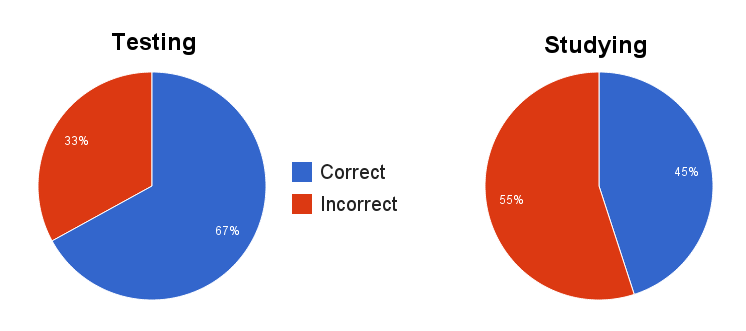
The testing effect is real. Dozens of studies show that you will recall l% more than of learned information by testing yourself than past using the same amount of time to study (for example, one research team found a score difference of 67% with testing vs. 45% with studying).
The good news is that all of these mistakes are reversible.
Research suggests that if you larn nearly the research underlying effective study strategies, you are more likely to abandon mythmaking, adopt effective approaches, and succeed on your test than people who take not been exposed to this information.
Now that nosotros've told you some mistakes to avoid…
How TO Report for Boards: 10 Ways to Prepare for Your Board Exam
Now that nosotros've told yous some mistakes to avoid when studying for the boards, here are some tips and strategies that are sure to aid you conquer this milestone and hopefully ease your anxiety along the way.
ane. Discover your learning way
The methods others utilize won't necessarily be every bit effective for you lot — including those used by members of your written report group. Are you a visual or an auditory learner? Finding out which style works best for you is something to consider in the early stages of preparing for board exams. If you are a visual learner, try videos (similar NEJM Quick Take). If you lot are an auditory learner, record lectures and play them dorsum. Adaptive learning works especially well for those looking for a dynamic experience that is based on learning theory and science.
two. Plan to put in the time
As we mentioned higher up, mastering the material you need to know for the boards will take some time — perhaps more than you bargained for. Between all of your obligations, information technology can exist difficult enough to find the fourth dimension to get enough sleep, let alone put it in an hour or ii of studying every dark leading up to the board exam. Before registering for your exam, do your best to allocate report hours over a larger flow of time. Check out this article for ways to fit studying into your schedule. It's best to plan months, or even a year in accelerate. The concluding thing you want to do is resort to cramming.
In a report done by Nate Kornell, spaced repetition of the material you're learning proved to exist more effective than cramming by 20%. Implementing spacing allows you to retain more information than cramming with a college recall rate.
Bonus tip: Try studying during your morning and evening commutes. All of that time adds up!
three. Showtime a study group
Preparing for board exams with your friends is a great way to help address each other's weaknesses. Yous may accept one area completely covered to the bespeak where y'all can be the instructor in that grouping, yet struggle immensely in another surface area. Endeavour to accept everyone agree on a set time to run across. Your discussions will go a long fashion.
Speaking of discussions, be sure to cheque out one of the NEJM Resident 360 discussions, like How to Ace Your Next Standardized Exam. Meet all of the advice residents and experts gave!
4. Avoid burnout
The concluding thing you want is to be burned out studying. It can be extremely beneficial to take study breaks. Research suggests that doing something you enjoy the mean solar day before the exam has a more positive upshot than continuing to written report upward to the last minute.
5. Exercise during your breaks
Co-ordinate to this written report reviewed by Harvard Health, those who exercise with moderate intensity 30 minutes per mean solar day, every mean solar day, have improved memory and concentration. If you experience as though y'all're in a fog, start exercising regularly. You may even find, like Dr. Monique Tello, that you can review your board exam materials at the gym!
vi. Take advantage of mobile resources to study for boards
There are numerous apps that can requite yous the tools to create your own flash cards and exams. This written report shows that students who use online studying tools have higher examination scores than students who don't. Reviewing board examination flash cards (or fill-in-the-bare questions like those in NEJM Knowledge+) on the bus is a lot easier than trying to search through a textbook for a specific review section.
7. Notice a improve study environment
Study somewhere that is gratuitous from as many distractions as possible. If y'all're reviewing notes — or better all the same, testing yourself — in front of a Telly, chances are yous won't be very productive. Find a tranquillity corner in your local library that yous tin can rely on for a focused study session.
8. Prioritize challenging subjects
Every bit nosotros noted above, it'due south tempting to procrastinate on the harder subjects — but you don't desire to be caught without enough fourth dimension to main them. Exercise you know what you lot know and what y'all don't know? Knowing which subjects nowadays the biggest challenge to you allows yous to decide how much time y'all'll dedicate to them versus reviewing what you're more than comfortable with.
9. Get enough slumber!
This study published in Nature shows that irregular sleep direct affects academic operation. Aim for at least vii hours of uninterrupted sleep.
10. Exam yourself
Testing yourself may only be the best manner to study for boards — as nosotros've noted, studying by reading over your materials and not testing yourself may be the biggest fault you lot can make in preparing for your exam exam. One constructive method of assessing your knowledge is to use exercise exams, which simulate the timed environment of the actual board exam you're taking.
The reason taking practice tests assistance is that they reinforce your knowledge by asking your brain to struggle with recalling the answers and practice tests can forbid the furnishings of stress on memory. According to this study by Smith et al., when participants' studied using practice tests, they experienced fewer of the typical negative furnishings of stress — such as forgetting the answers.
Existence prepared for test day means knowing what information technology feels like to take the exam under pressure. For example, NEJM Knowledge+ contains two 60-question exercise exams that simulate the actual timed exam. Questions in the do exams align with the exam design. Adding this layer of realism to your prep can increase your confidence and help you exist more confident on test solar day.
There you lot have it—HOW TO Study FOR THE BOARDS—ten common mistakes to avoid and 10 tips and strategies that will help you to build confidence, maximize your report time, and laissez passer the examination!
Studying for Boards: More Study Tips and Resources from NEJM Knowledge+
- Board Review Study Tips
- Download a gratis customized learning guide that matches your learning fashion.
- Taking the Internal Medicine Board Exam
- Taking the Family unit Medicine Board Examination
- Taking the PANCE/PANRE Exam
- Taking the Pediatrics Board Test
Internal Medicine Board Review from NEJM Knowledge+
Comments are closed.
Source: https://knowledgeplus.nejm.org/blog/10-mistakes-studying-for-the-boards/
0 Response to "Unfortunately I Only Study the Review Questions on Page -------(562 Five Hundred Sixt-two)"
Post a Comment